
Asian CricketIndia's Historic Powerplay Blitz in Wellington: 118/0 in Six Overs, 199 Chased Down in 13.2 Overs
India's Historic Powerplay Blitz in Wellington: 118/0 in Six Overs, 199 Chased Down in 13.2 Overs
भारत ने वेलिंगटन में न्यूजीलैंड के खिलाफ तीसरे टी20 अंतरराष्ट्रीय में 199 रन का लक्ष्य 13.2 ओवर में चार विकेट पर हासिल कर छह विकेट से जीत दर्ज की और 40 गेंदें शेष रहीं। पावरप्ले में भारत ने बिना विकेट 118 रन बनाए (36 गेंदों पर 19.67 रन प्रति ओवर), जो फुल मेंबर देश द्वारा टी20 अंतरराष्ट्रीय इतिहास का सर्वश्रेष्ठ पावरप्ले माना जा रहा है। अभिषेक शर्मा 20 गेंदों पर नाबाद 57 (स्ट्राइक रेट 285.0) और वैभव सूर्यवंशी 17 गेंदों पर नाबाद 44 (258.8) रहे। हालांकि इन आंकड़ों में गणितीय असंगति है: 37 गेंदें बनाम 36 वैध गेंदें, 101 रन बनाम 118 का पावरप्ले स्कोर, और दोनों बल्लेबाजों का नाबाद होना बनाम 199/4 का टीम स्कोर। न्यूजीलैंड ने 198/3 बनाया था, जिसे भारतीय गेंदबाजी की कमजोरी के संकेत के रूप में देखा जा रहा है, पर यह सुर्खियों में नहीं आया। रिकॉर्ड दावों और व्यक्तिगत स्कोरों की आधिकारिक स्कोरकार्ड से पुष्टि आवश्यक है।
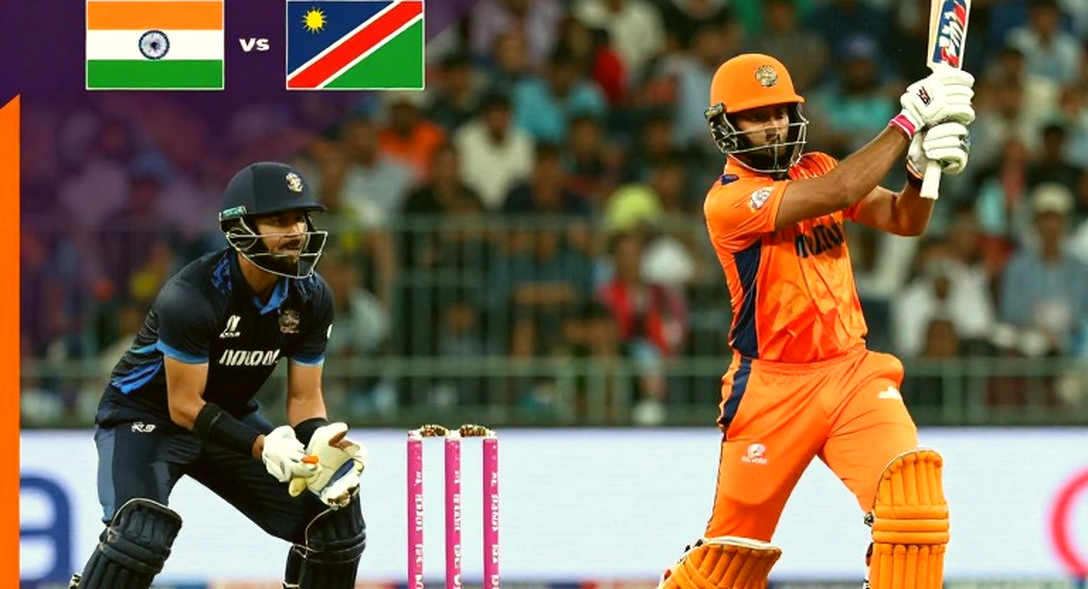
Wellington. India's chase of 199 against New Zealand in the third T20I was over inside six overs. The tourists raced to 118 without loss in the powerplay — 19.67 runs per over across 36 legal balls — and completed the chase at 199/4 in 13.2 overs, winning by six wickets with 40 balls unused. The series lead is now described as an unassailable 3-0, though the exact length of the series requires verification.
The structural point matters more than the scoreline. India scored 59.3 per cent of the target in 30 per cent of the available overs. Abhishek Sharma made 57 not out off 20 balls at a strike rate of 285.0; Vaibhav Sooryavanshi, described as a 'promoted' batter, made 44 not out off 17 at 258.8. Together: 101 off 37 balls at 272.9. The paired nature of the assault is the more meaningful signal — two batters striking above 250 simultaneously strips the fielding captain of his only containment lever, which is to bowl one end tight and attack from the other.
But three figures in the available report cannot all be true under standard scoring logic. First, 20 plus 17 balls faced equals 37, while a powerplay contains only 36 legal balls; this survives only if a no-ball fell inside the six overs, since wides do not count as balls faced. Second, 57 plus 44 equals 101, which is less than the 118 powerplay total — that would require at least 17 extras in 36 balls. Third, both batters are described as unbeaten at the end, yet India finished 199/4; if both openers batted through, no other batter could have been dismissed. Either the individual scores are a mid-innings snapshot or one headline number is a transcription error. This is arithmetic, not speculation, and none of these figures should be propagated until checked against an official match centre.
After the powerplay, India needed 81 off 84 balls, or 5.79 an over, down from 9.95 at the start. The remaining 44 balls produced 81 runs and four wickets at 11.05 an over — low-leverage dismissals at a required rate below six. The margin of victory understates India's dominance; the four wickets overstate the difficulty. The report itself concedes the finish needed 'a little luck'.
The number missing from the story is New Zealand's 198/3. Nine point nine an over is a par-plus total at most venues, not a batting failure. But a Full Member attack taking only three wickets across 20 overs on a good surface is the unresolved data point of the match, and it has been entirely displaced by the batting headline. No New Zealand bowler is named anywhere in the source, which prevents any assessment of the quality of the attack faced — a material omission, and one that matters if the home side rotated personnel.
On the records themselves: the previous powerplay mark belongs to Romania against Serbia, and the joint-fastest fifty is shared with Papua New Guinea against Vanuatu and Romania against Serbia. Cricket's record tables mix Full Member and Associate fixtures in one list, which inflates raw 'world record' claims. The report applies the correct corrective lens in one place — it explicitly separates the Full Member benchmark for the five-over hundred, noting India are the fastest Full Member, ahead of South Africa and Australia — but reports the powerplay record against the all-comers figure without a Full Member comparator. That is an inconsistency in analytical rigour within a single piece.
The sourcing language is the governance issue here, not the cricket. Phrases such as 'according to reported figures' and 'where data is available' signal that the piece is not built on an official scorecard. For record claims that will be repeated globally, that is below the appropriate evidentiary standard. The reference to Eswatini against Mozambique earlier in 2026 implies either that the article dates from 2026 or that the year is a transcription error; either way the fixture sits outside verifiable published records.
Conditions appear batting-friendly. Both sides scored at close to or above 10 an over, New Zealand at 9.90 and India at 14.93, suggesting a flat pitch and a fast outfield with short boundaries. Toss, day-night status, dew and weather are not stated; if the match was floodlit, dew would typically favour the chasing side. The venue name as reported does not match a standard Wellington international ground and requires verification. Similarly, a '3-0 unassailable lead' after match three implies a series of at least four, most likely five, matches — inconsistent with a standard three-match series, where 3-0 would be a clean sweep, not an unassailable lead.
On players: neither innings supports a technique conclusion. Twenty and seventeen balls are far below any credible threshold; the correct classification is an outlier shot-making sample. Sooryavanshi carries the higher hype risk — his age, caps and career record are not disclosed, so the fulfilment probability for any 'next big thing' narrative is unknowable from this text. Workload and physical maturity for a young, promoted batter sustaining that strike rate are legitimate concerns, and no fitness data is supplied for either player.
On the broader picture, this is a single innings in a bilateral series. No series-level trend and no format-level conclusion can be extracted from it. An away 3-0 lead against New Zealand is a genuinely stronger signal than an equivalent home display, and a record powerplay by a Full Member against a Full Member, away, in a completed chase, is a substantive performance. But record totals against Associate bowling are common; the Full Member-specific comparison is what gives this one evidentiary weight. India's selection pattern suggests a pre-planned high-risk top-order strategy rather than an improvised assault.
The dominant risk in this item is narrative, not sporting. Peak-heat reporting on record innings systematically over-weights the outlier and under-weights conditions, opposition attack composition and sample size. The two real cricket risks are structural and both predate this match: India's wicket-taking in the middle overs, and an untested middle order that has not had to chase nine-plus an over under pressure in this series. The most likely reversal mechanism is not Indian batting decline but a low-scoring surface or a full-strength attack in the remaining fixtures.
Commercially, no direct analysis is possible: there is no broadcast, salary, league or ownership information in the source. The only credible industrial effect is on short-form content value and on the market perception of one young player's brand. The most interesting industry read-across is the talent pipeline — promoting a young batter into a powerplay assault role in an away T20I is a structural statement about a pathway that now rewards intent-first batters rather than accumulators. That is worth tracking over the next 12 months.
Signals to watch: Sooryavanshi's next five innings, India's wicket-taking in overs seven to fifteen, New Zealand's powerplay economy, official scorecard confirmation of the individual figures, and pitch-type variance in the remaining fixtures. The core judgment is that India produced a genuinely elite away powerplay; the records are real, but the supporting figures do not reconcile, the key comparative benchmark is buried under Associate-cricket record inflation, and the most diagnostically important number in the match is absent from the story.
संबंधित खिलाड़ी
लोकप्रिय/पसंदीदा पुस्तकें
Empty Data, Full Verdict: The Cricket Analysis Report With No Cricket In It2026-11-12
Pakistan Zindabad League: 64 Teams, a Rs 1.55 Crore Prize, and Three Decisive Matches in One Night2026-11-12
Before Analysing Asian Cricket: Missing Information Prevents a Reliable Assessment2026-11-12
Sylhet to Johannesburg: Two Tests, Five Days, and a Seat Left Empty at 4 a.m.2026-11-12
अनुशंसित
A 'Temple' on the Forehead and Five Wickets on the Card: Shubman Gill's Patch Is Cricket's New Question2026-11-05
A Fifty in 14 Balls: Prema Rawat's World Record and the Ledger Behind It2026-11-05
Testimony of an Empty Notebook: When Nothing Was Placed on the Cricket Analyst's Table2026-11-03
Hampshire's Relegation and Domingo's Exit: One Season, Three Different Measures2026-11-09
An Empty File and a Mumbai Dossier: The Fine Web of Cricket Custodianship2026-11-03
Hamilton's 191: Where the Pitch Excuse Collided With an 11.9 Run Rate2026-11-02
Beyond the Toss at Newlands: South Africa’s Lost Grip, Australia’s Uncertainty and the Rise of SA202026-11-07
अनुशंसित
The Archaeology of the Empty Ledger: What Indian Cricket Never Counts2026-11-09
Missing Cricket Data: Why Match, Player and Team Analysis Remains Impossible2026-11-08
Ticking Bomb or a Quiet Hip: Rohit Sharma, 2027, and the Other Half of the Sentence2026-10-27
Wellington's Grass and Eight Days: What Sitanshu Kotak's Briefing on Arshdeep, Gurnoor and Auqib Says, and What It Leaves Blank2026-11-11
Livingstone's 13 to 6 Crore Journey: Why the CSK-SRH Trade Hides the Real Story of the Contract2026-11-06
No Basis for an Asian Cricket Report: The Analysis Package Contains No Facts2026-11-11
Sylhet, Day 3: Hridoy's 109-Ball Fifty and the Expensive Shots Around Him2026-11-08